
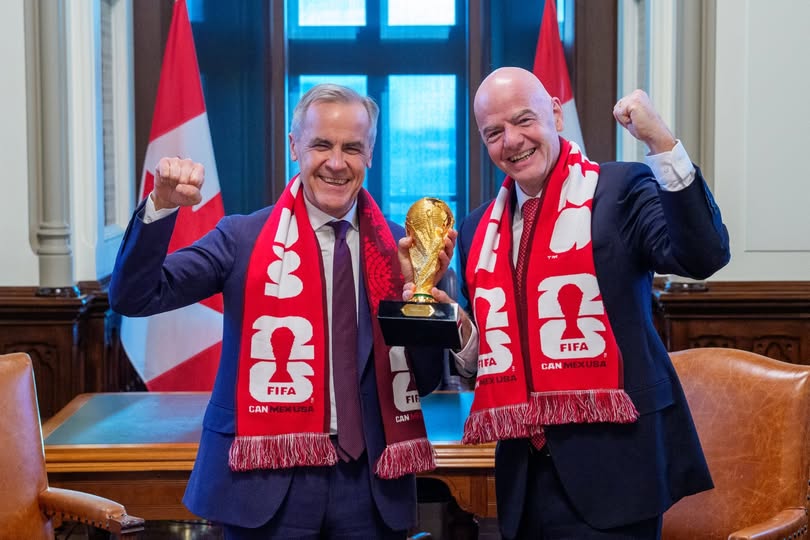
The 2026 FIFA World Cup is the largest version in history, with 48 teams and 104 matches. More teams are included, and the knockout round is expanded. For the first time in history, Canada is a host of the biggest global sporting event. This should be a scenario in which the positives far outweigh the negatives, but it’s not.
Canadians are paying for the World Cup, while the World Cup practices price gauging, making it very difficult for the average Canadian to afford to enjoy the event they are forced to pay for.
The tournament is expected to cost Canada over a billion dollars in public spending for just 13 matches, roughly $82 million per game. At the same time, fans are facing some of the most expensive World Cup Tickets by far ever sold, while FIFA keeps the vast majority of the revenue. Perhaps most frustrating is that the event represents a squandered opportunity to build something permanent and valuable for Canadians.
Some justify the high costs by pointing to previous versions of the tournament being expensive to the hosts, however, this falls flat when you consider that over each of the last 5 World Cups, the host nation has built 5 or more brand new stadiums.
This is not just poor value, it’s a multi-layered rip-off.
A Blank Check to FIFA
The host cities of Toronto and Vancouver effectively signed open-ended hosting agreements that committed taxpayers to covering FIFA’s escalating costs, which have led to soaring expenses.
Canadian taxpayers are on the hook for $1.066 billion dollars (CAD). The initial projected costs to be a co-host of the tournament were just over $500 million to federal and city governments.
Toronto initially expected to pay $30 to $45 million to be a host city when city councillors approved the first bid to host 5 games. That estimate has since grown to $380 million for 6 games.
Vancouver initially estimated to pay $230 million for 5 games. They are now estimated to pay over $700 million for 7 games.
Turns out, signing a blank check to FIFA went about as well as any sensible person would have expected. FIFA fully demonstrated their moral compass last World Cup when they barely batted an eye when thousands of migrant workers died in unsafe and abusive conditions ahead of the 2022 World Cup in Qatar, garnering much criticism from human rights groups.
Temporary Upgrades, Permanent Costs
Toronto’s BMO Field received roughly $158 million in upgrades. The dominant feature was the addition of 17,000+ temporary seats on massive scaffolding structures behind the goals to meet FIFA’s capacity requirements. These seats will be removed after the tournament. While some permanent improvements were made, such as upgrades to the lighting, 4 new LED video boards, and upgrades to the locker rooms.
In Vancouver, BC Place received more noticeable work, but the Whitecaps have faced major disruption during preparations and continue to deal with long-standing stadium lease and economic challenges, with reports of potential relocation interest from Las Vegas groups.
For the scale of public money involved, it feels like there could have been more value in terms of permanent infrastructure.
Ticket Price Rip-Offs: More Games, Much Higher Prices
Despite the expanded format delivering far more matches than previous tournaments, ticket prices are dramatically higher.
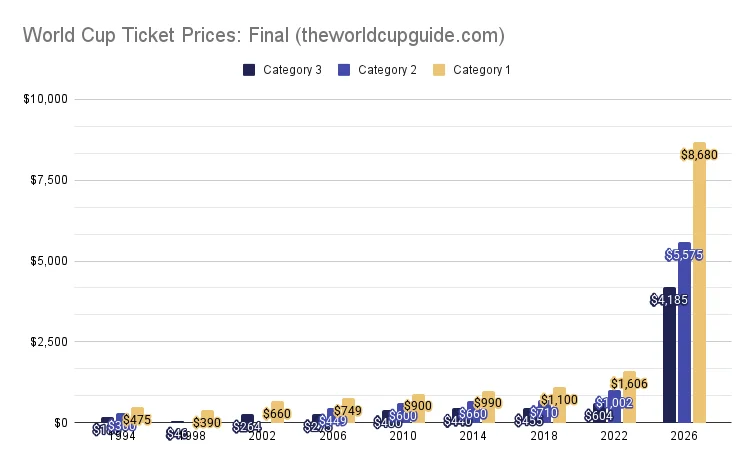
In Canada, tickets for Canada’s opening match in Toronto started above $1,000 for nosebleed seats, with remaining inventory often between $1,370 and $3,100+. Many matches in both Toronto and Vancouver still have hundreds or thousands of unsold tickets just days before the tournament.
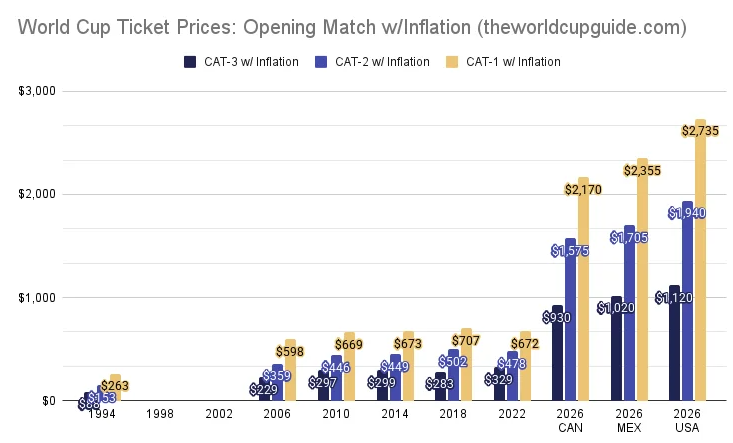
Traditional deep local discounts were a feature in all of the last 5 World Cups, but this has been reduced for 2026 in favour of higher overall pricing with limited affordable options. It’s a slap in the face to Canadians.
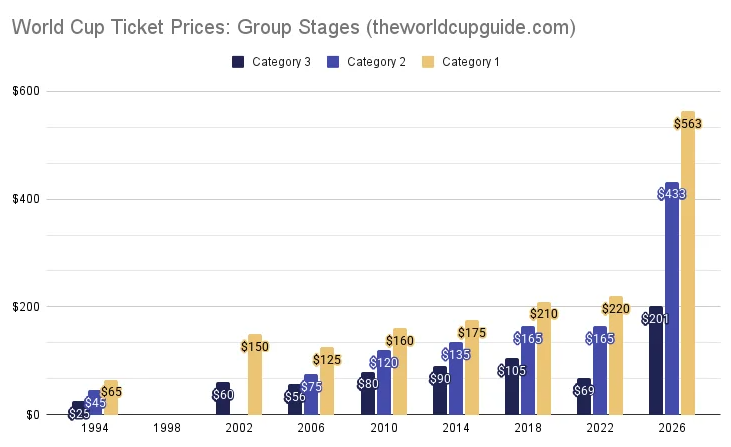
Historical pricing graphs courtesy of The World Cup Guide.
Hiding Poor Sales: Dumping Tickets to Secondary Markets
Rather than lowering official face-value prices, which could spring refunding fans who already paid more in earlier sales phases, there is evidence suggesting that FIFA has been moving large blocks of unsold inventory onto secondary resale platforms such as SeatGeek and StubHub. Entire sections have appeared suddenly at discounted rates. This approach allows the organization to move tickets without admitting weak demand or issuing refunds, while many fans who bought early at premium prices now feel cheated. Secondary market prices have already dropped 20–23% in recent weeks as supply increases.
FIFA Keeps the Money, Hosts Pay the Bills
FIFA controls ticket sales, broadcasting rights, and sponsorships. Host cities and countries shoulder the majority of the costs of security, infrastructure, operations, and venue preparations, but receive none of the ticket revenue. FIFA is on track to generate a record $13 billion from the 2026 cycle. Canadian taxpayers are effectively subsidizing FIFA’s profits while receiving only indirect tourism spending in return.
A Missed Opportunity for Real, Lasting Legacy
Major sporting events have historically been used to create permanent infrastructure that benefits a country for decades. The 1976 Montreal Olympics, despite its problems, delivered the Olympic Stadium, which went on to serve as a long-term home for professional teams including the Montreal Expos and Montreal Alouettes.
The 2026 World Cup could have followed a similar path — but with far better results. Instead of temporary scaffolding, the money could have funded a proper, permanent, world-class stadium.
Estadio Azteca in Mexico City shows what is possible. Opened in 1966 with a current capacity of over 87,500, it is one of the most iconic stadiums in the world. It has hosted two FIFA World Cup finals (1970 and 1986) and will host matches again in 2026. It is the permanent home of Club América, has hosted the Mexico national team for decades, and has staged legendary matches and massive concerts.
The Estadio Azteca was built to serve as the premier venue for the 1970 FIFA World Cup and the 1968 Summer Olympics futball tournament. It continues to generate revenue, pride, and cultural significance more than 60 years later.
The World Cup would have been a great chance to build something for Canada on a smaller scale that would have served as a great venue for years to come and house MLS and CFL play as well as future international football events. What if one of the host cities was Quebec City with a newly built stadium to host the World Cup and also serve as the home for a CFL and possibly MLS team? That would be a multi-decade win.
To put that $1 billion price tag into perspective:
- Princess Auto Stadium, home of the Winnipeg Blue Bombers, cost $210 million ($290 million in today’s money) and opened in 2013 with a 32,343 capacity.
- Mosaic Stadium, home of the Saskatchewan Roughriders, cost $278 million ($360 million in today’s money) and opened in 2017 with a 33,350 capacity.
How Does Canada’s Experience Compare to the United States?
Many of the problems Canada is facing are also playing out south of the border. American host cities have also dealt with major cost overruns, extremely high ticket prices, and evidence of FIFA moving unsold inventory to secondary markets rather than lowering face-value prices. However, the United States has some advantages Canada lacks, such as 11 host cities and the majority of the matches, many venues are existing NFL stadiums with high-quality infrastructure already.
Even with these advantages, ticket prices remain a major source of anger across the U.S., and several American cities are also reporting significant numbers of unsold seats. The core issue of FIFA shifting costs onto host governments while keeping the commercial revenue is the same on both sides of the border, with skyrocketing ticket prices that bar the peasants from attending the event they paid for.
The Bottom Line
Canadian taxpayers and fans are being squeezed from every direction:
- They are paying over $1 billion in public money for mostly temporary infrastructure.
- They are facing some of the most expensive World Cup tickets in history.
- They are seeing none of the direct ticket revenue.
- They are being asked to support an organization with a troubling human rights record.
- And they watched a rare chance to build lasting sporting infrastructure slip away.
The 2026 World Cup will produce some exciting moments on the pitch. My expectations for the Canadian men’s team have never been higher. But for many Canadians, it stands as a clear example of short-term spectacle over long-term value. A multi-layered rip-off dressed up as a global celebration.




Leave a Reply